
Congratulations to both Dr. Nathan Tabor (Associate Professor, Western Michigan University) and Dr. Ilyas Chattha (Professor, LUMS) for receiving the 2026 AIPS Book Prize! This year, the AIPS Book Prize Committee selected two books for the annual award. Please see the committee’s comments below:
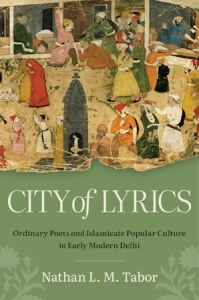
City of Lyrics: Ordinary Poets and Islamicate Popular Culture in Early Modern Delhi (The University of North Carolina Press)
“Nathan Tabor’s impressive study of the emerging culture of poetic gatherings (mushāʿirahs) in eighteenth- century Delhi demonstrates how sprawling networks of “ordinary poets” shaped Urdu as a rising literary language. By setting his examination of minor poets from many different regions, Nathan demonstrates how the urban history of one city can still speak to the wider trans-regional, multilingual, entangled histories of Urdu and Persian literary cultures. He offers compelling evidence for the ways in which poetic exchanges helped to anchor friendships and also fueled rivalries, spurring poets to constantly innovate and create new poetic forms. Drawing from a vast, multi-lingual cannon, poets reframed established tropes, affective registers, and literary convention to shape new aesthetic forms, meaning, and even ethical ideas. The competitive space of the mushāʿirah also shaped new forms of belonging and exclusion and both reflected and remade social hierarchies. This is a rich compelling social history of a literary culture written in an extremely engaging and accessible manner. Tabor’s makes a persuasive case for how Urdu emerges as a global language, by drawing attention to the rich agency of non-elite participants in mushāʿirah culture both in the eighteenth century, and in our own time.”
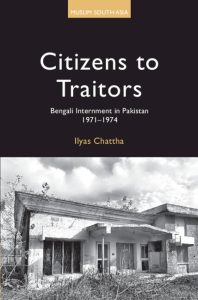
Citizens to Traitors: Bengali Internment in Pakistan, 1971-1974 (Cambridge University Press)
“In a path-breaking contribution, Ilyas Chattha recovers the silenced history of elite and ordinary residents of Pakistan who were transformed by the 1971 Bangladesh war from rights-bearing citizens to ethnically marked ‘others’, now suspected traitors, able to be stripped of political and human rights and subjected to indefinite internment. Drawing upon period journalism, neglected official and personal correspondence and records, oral histories, and visits to former internment facilities Chattha reconstructs and contextualizes the suppressed narratives of Bengali officials, students, and workers living in West Pakistan who often lost everything during the 1971-74 Bangladesh war and post-war years. Their often complex transregional identities, livelihoods, and prospects were transformed by new nationalist ‘imagined community’ dynamics that too easily denaturalized, held hostage, and finally erased inconvenient individuals and communities.”